




SALALAH: Greater Salalah’s new structural framework proposes integrating the Port of Salalah, Salalah Free Zone and Salalah Airport into a single economic growth strategy, aiming to strengthen links between logistics, manufacturing, investment and urban development as the city prepares for long-term expansion through 2040.
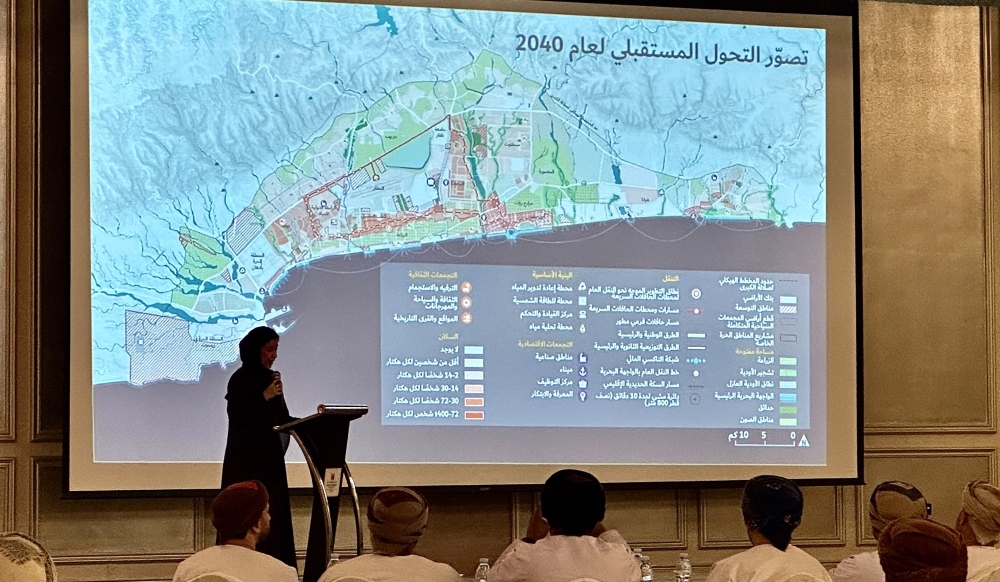
Presented during a workshop on the final framework of the Greater Salalah Structure Plan earlier this week, the proposal moves beyond treating the three assets as standalone infrastructure, instead positioning them as interconnected drivers of economic activity supported by coordinated land use, transport planning and future investment.
The framework identifies the Port and Free Zone, Airport City Logistics Hub and surrounding urban districts as strategic growth areas intended to work together to generate broader economic value across Greater Salalah.
At the centre of the approach is a recognition that world-class transport infrastructure alone does not automatically translate into wider economic gains. The framework therefore seeks to strengthen the links between cargo movement, manufacturing, industrial investment, commercial services, employment and urban development so that growth generated by the city’s gateways extends across the wider economy.
Planning scenarios presented during the workshop identify the Port and Free Zone as Greater Salalah’s largest employment and production centre over the coming decades. Employment in the district is projected to increase from around 51,600 in 2024 to nearly 87,650 by 2040, while its gross domestic product is projected to rise from approximately RO 1.04 billion to about RO 2.82 billion over the same period.
The framework notes that these figures are planning scenarios intended to support long-term development and will depend on investment, market conditions and project implementation.
Alongside the port and free zone, the framework identifies an Airport City Logistics Hub as a strategic investment location designed to strengthen airport-related logistics and support higher-value economic activity.
It also proposes an Innovation District to encourage research and knowledge-based industries, together with a Raysut Pharmaceutical Precinct intended to support pharmaceutical manufacturing and associated logistics.
Rather than functioning as isolated investment zones, the framework envisages these locations operating as complementary economic clusters linked through transport infrastructure, supporting services and coordinated urban planning.
The proposal also calls for a dedicated master plan for the Port and Free Zone to help align future industrial expansion with transport networks, land use, environmental considerations and supporting infrastructure.
Eng Aseela al Busaidi, Technical Director of the Greater Salalah Structure Plan at the Ministry of Housing and Urban Planning, said the framework was designed around an integrated planning philosophy.
“We are not dealing with separate projects, but with an integrated system in which every project supports the others and every investment creates added value for its surroundings,” she said.
Al Busaidi said the structure plan represents an integrated roadmap to 2040, bringing together economic diversification, transport, infrastructure, environmental sustainability and urban development within a single planning framework.
She added that completing the plan marked the beginning of implementation rather than the end of the planning process, stressing that its success would depend on sustained cooperation among government entities and stakeholders to translate the vision into tangible projects.
If implemented, the framework would represent a shift in the role of Salalah’s strategic assets—from transport gateways operating largely as individual facilities towards a more connected economic platform designed to support investment, industry and long-term regional growth.
Oman Observer is now on the WhatsApp channel. Click here